Saturday, November 9, 2013

November 2013 - three classes: 'I'm a scientist'


'I'm a scientist'

I start another bout of evening classes for parents and children this coming Monday. As always, I'm looking forward to working with those young minds, full of curiosity about the world around them

21 parents and their kids (grand total about 60, I think) are coming to have some fun interacting with science challenges.

I'll keep you posted as to how it goes!!

Oh, if anyone would like the handbook (I'm a scientist booklet) I've written to go with the classes, just let me know and I'll put one in the post.

So, Class One.

Monday, November 11th.........Mid afternoon, I packed the back of my car with oodles of resources (junk stuff, like newspaper, used typing paper, recycled paper clips) for this first workshop, and then spent over an hour setting up the room at the nearby Fire Department/HOA HQ. Paul Kennedy, a friend and the sharpest guy on the block, and Laurie Rondou, the super teacher second grade from Mountain View, came and helped me set up the tables and chairs. It's a small room, and I wasn't too sure how the seating would work out. So, I crossed my fingers and squeezed my wishing rock, hoping for the best.

Setting up my workshop
Lots of tables crammed into a small space.....


On each table, we put out copies of the booklet, I'm a scientist, and the separate sheets with all
of the evening's activities

and I displayed examples of my tins and towers and balancing figures and.............

Some of my bits and bobs that I put on the big table at the end of the room.

And in came the 53 young and parent scientists!

I spent a few minutes showing them my wishing rock and described how and when I became a scientist..........then I set them their first challenge: draw a Picassoesque image of each young scientist, the, when the laughter ceased, make a newspaper bridge that links two tables. The bridge has to be strong enough to hold a brick!!
And we started....................with  Laurie and Paul at hand, the room soon buzzed with excited young scientists....


Then, make a tower......that holds an orange!
Maggie didn't take long!


Once the bridges and towers were in place, the next challenge was to make a variety of paper figures that could balance on the towers...........


Elias did a great job! What a young scientist!

Brodie took a break to nibble at the goldfish.......and shared some with me!


And the senior scientists admired the inventiveness and ingenuity of their young scientists......


The session went really well. Near the end, I gave every young scientist a cottonwood twig to break.....and they all found a beautiful star. Then I handed out a scavenger hunt sheet.............something that would encourage the young scientists to search the 'wild' areas around their homes.


CLASS TWO - investigating FLIGHT
Again, up at the workroom really early, setting up for the flight activities.

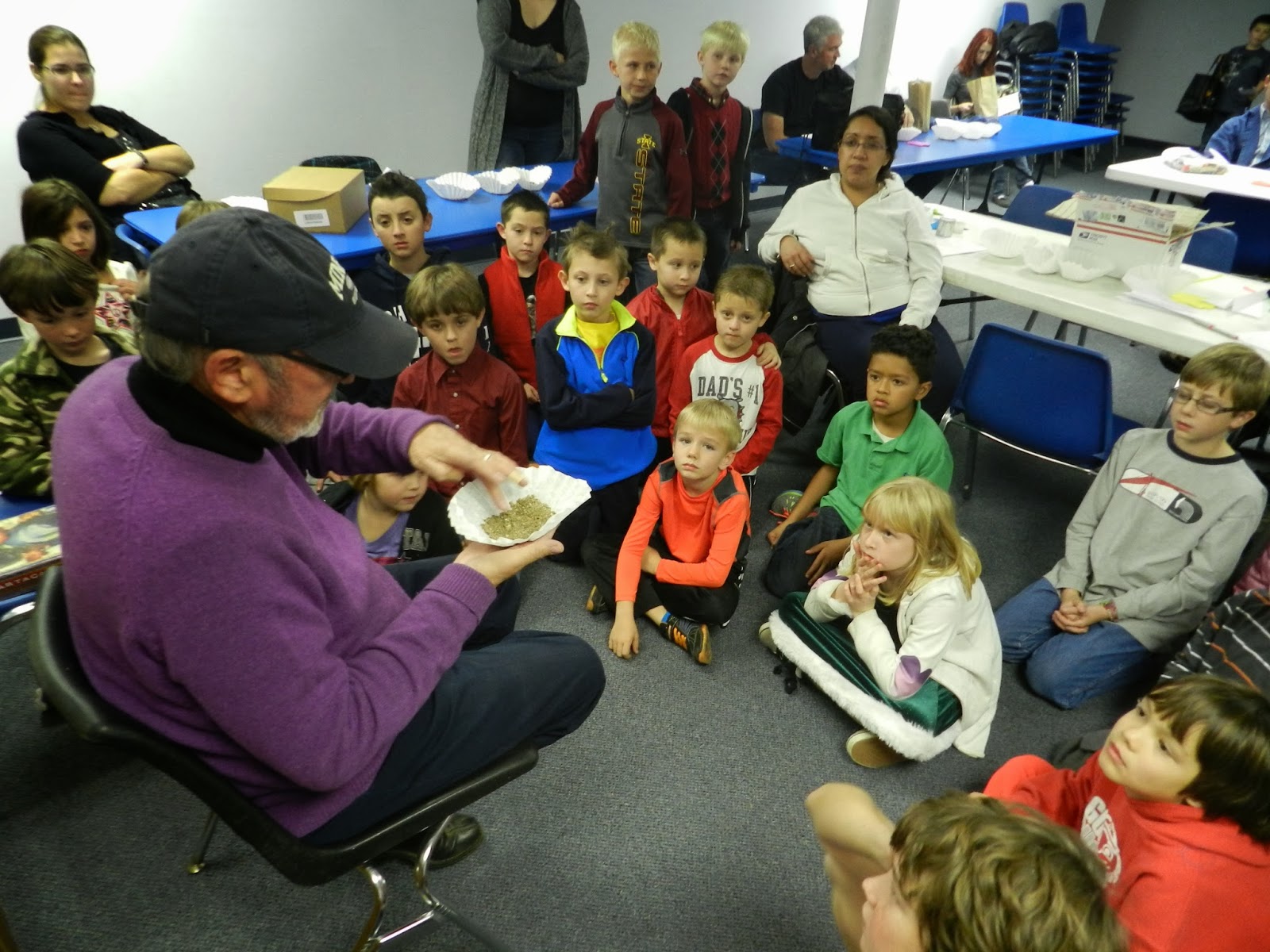
First, though, I gathered the children around me and we shared our collections.........and then I showed them how to make a pocket museum.


I showed them what I had found the day before the class.......an arrow head and an owl pellet!

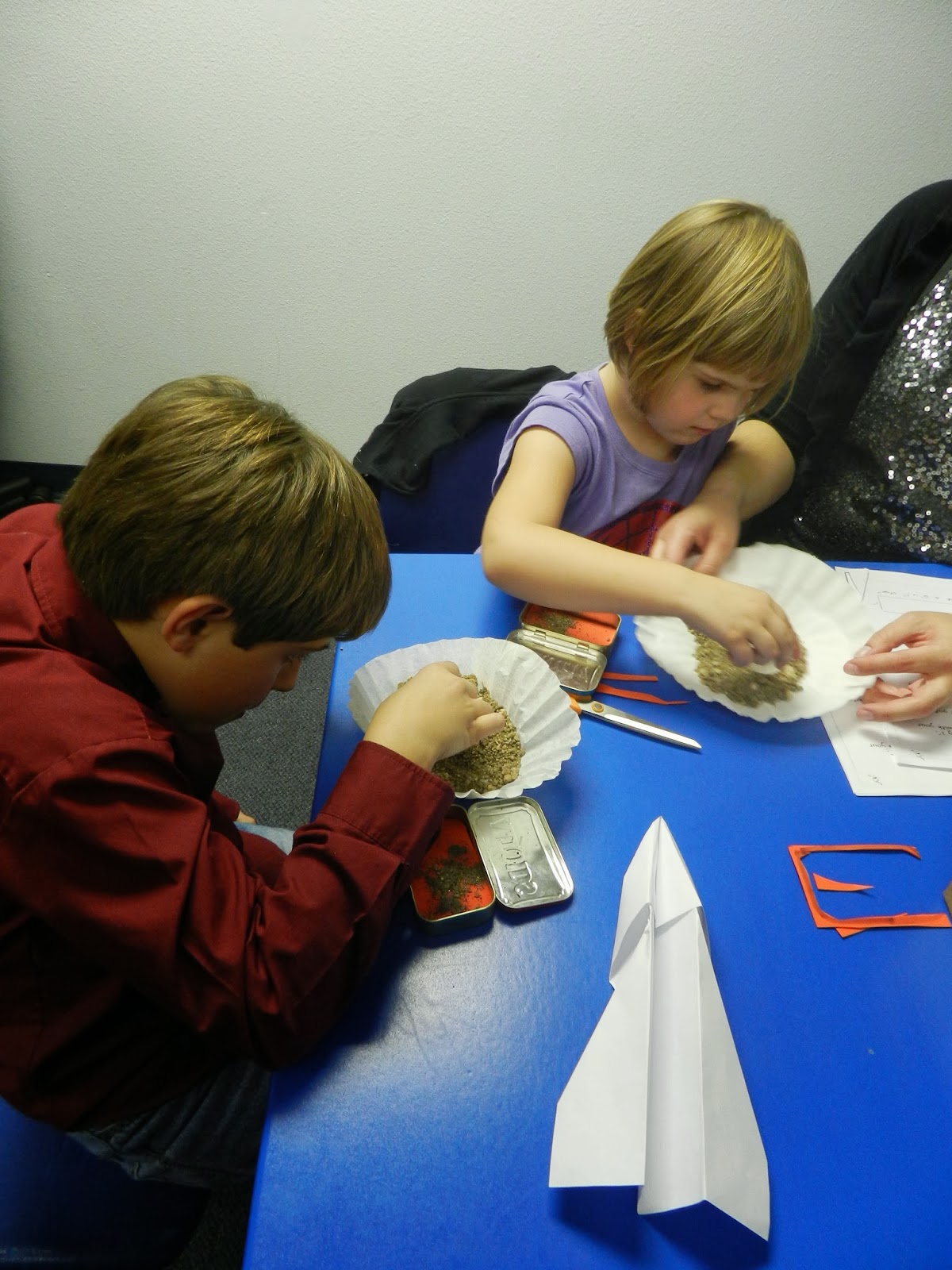
Then I showed them how to find meteor dust............


and went into the making and flying of different paper shapes

even standing on a chair, holding up my arms, and releasing the flying objects......


The young scientists soon got to work!

First, though, they had chance to search for meteorite crystals, digging in sand from the nearby creek, using a magnet to attract anything that was magnetic

and there were plenty of magnetic crystals..........GREAT!


papercopters


and we finished with launching our air propelled rockets.......

whose flew the furthest?


Thanksgiving activity - find and clean the wishbone, the link between modern and ancient birds.
Add caption

Oh, tip for the day: use your egg boxes as display boxes for your rocks and fossils.....


Class Three


Again, set up very early for the evening ahead.................
Making flip flops, marble runs and a variety of dragsters

First, flip flops, and then straight into the marble runs.....


The class went well........and ended with the presentation of certificates to all the young scientists!
PHEW!!


So, when and where do I do the next lot of classes? Think I'll concentrate on Chemistry next time..........

Hey, that was fun...exhausting, but fun!

Thank you, Young Scientists.
You were ALL great!


Tuesday, November 5, 2013

I'm going, as soon as the public transport system is in place.....


The New York Times


November 4, 2013

Far-Off Planets Like the Earth Dot the Galaxy

The known odds of something — or someone — living far, far away from Earth improved beyond astronomers’ boldest dreams on Monday.
Astronomers reported that there could be as many as 40 billion habitable Earth-size planets in the galaxy, based on a new analysis of data from NASA’s Kepler spacecraft.
One out of every five sunlike stars in the galaxy has a planet the size of Earth circling it in the Goldilocks zone — not too hot, not too cold — where surface temperatures should be compatible with liquid water, according to a herculean three-year calculation based on data from the Kepler spacecraft by Erik Petigura, a graduate student at the University of California, Berkeley.
Mr. Petigura’s analysis represents a major step toward the main goal of the Kepler mission, which was to measure what fraction of sunlike stars in the galaxy have Earth-size planets. Sometimes called eta-Earth, it is an important factor in the so-called Drake equation used to estimate the number of intelligent civilizations in the universe. Mr. Petigura’s paper, published Monday in the journal Proceedings of the National Academy of Sciences, puts another smiley face on a cosmos that has gotten increasingly friendly and fecund-looking over the last 20 years.
“It seems that the universe produces plentiful real estate for life that somehow resembles life on Earth,” Mr. Petigura said.
Over the last two decades, astronomers have logged more than 1,000 planets around other stars, so-called exoplanets, and Kepler, in its four years of life before being derailed by a mechanical pointing malfunction last winter, has compiled a list of some 3,500 more candidates. The new result could steer plans in the next few years and decades to find a twin of the Earth — Earth 2.0, in the argot — that is close enough to here to study.
The nearest such planet might be only 12 light-years away. “Such a star would be visible to the naked eye,” Mr. Petigura said.
His result builds on a report earlier this year by David Charbonneau and Courtney Dressing of the Harvard-Smithsonian Center for Astrophysics, who found that about 15 percent of the smaller and more numerous stars known as red dwarfs have Earth-like planets in their habitable zones. Using slightly less conservative assumptions, Ravi Kopparapu of Pennsylvania State University found that half of all red dwarfs have such planets.

Animation by UC Berkeley/UH-Manoa/Illumina Studios

Galaxy contains billions of potentially habitable planets, say University of California at Berkeley and University of Hawaii at Manoa astronomers.
Geoffrey Marcy of the University of California, Berkeley, who supervised Mr. Petigura’s research and was a co-author of the paper along with Andrew Howard of the University of Hawaii, said: “This is the most important work I’ve ever been involved with. This is it. Are there inhabitable Earths out there?”
“I’m feeling a little tingly,” he said.
At a news conference Friday discussing the results, astronomers erupted in praise of the Kepler mission and its team. Natalie Batalha, a Kepler leader from the NASA Ames Research Center, described the project and its members as “the best of humanity rising to the occasion.”
According to Mr. Petigura’s new calculation, the fraction of stars with Earth-like planets is 22 percent, plus or minus 8 percent, depending on exactly how you define the habitable zone.
There are several caveats. Although these planets are Earth-size, nobody knows what their masses are and thus whether they are rocky like the Earth, or balls of ice or gas, let alone whether anything can, or does — or ever will — live on them.
There is reason to believe, from recent observations of other worlds, however, that at least some Earth-size planets, if not all of them, are indeed rocky. Last week, two groups of astronomers announced that an Earth-size planet named Kepler 78b that orbits its sun in 8.5 hours has the same density as the Earth, though it is too hot to support life.
“Nature,” as Mr. Petigura put it, “knows how to make rocky Earth-size planets.”
Also, the number is more uncertain than it might have been because Kepler’s pointing system failed before it could complete its prime survey. As a result, Mr. Petigura and his colleagues had to extrapolate from planets slightly larger than Earth and with slightly smaller, tighter orbits. For the purposes of his analysis “Earth-size” was anything from one to two times the diameter of the Earth, and Earth-like orbits were between 400 and 200 days.
Dr. Batalha said, “We don’t yet have any planet candidates that are exact analogues of the Earth in terms of size, orbit or star type.”
Though Kepler itself is sidelined while astronomers devise a new program it can accomplish with less flexible pointing ability, it has sent back so much data that there is still a whole year’s worth of results left to analyze, Dr. Batalha said. “Scientists,” she said, “are going to work on Kepler data for decades.” Kepler was launched in 2009 to perform a kind of cosmic census, monitoring the brightness of 150,000 far-off stars in the Cygnus and Lyra constellations, looking for dips in brightness when planets pass in front of them.
Mr. Petigura and his colleagues restricted themselves to a subset of some 42,000 brighter and well-behaved stars. They found 603 planets, of which 10 were between one Earth and two Earths in diameter, and circled in what Mr. Petigura defined as the habitable zone, where they would receive between a quarter of the light the Earth gets, and four times as much. In the solar system, that zone would spread from inside the orbit of Venus to just outside the orbit of Mars.
Meanwhile, in an innovation borrowed from other data-intensive fields like particle physics, Mr. Petigura designed a computer pipeline so that he could inject fake planets into the data — 40,000 in all — and see how efficiently his program could detect planets of different sizes and orbits. In addition to that correction, he and his colleagues had to correct for geometry; only about one in 100 planet systems is aligned edge-on so that earthlings would see the telltale wink of an exoplanet transit.
“It was a ton of work,” he recalled, explaining that he had to try out tens of billions of different periods for each star in order to find planets.
Sara Seager, an exoplanet astronomer at the Massachusetts Institute of Technology who was not involved in the work, said the pipeline testing had made the results believable. “I would say that small planets are everywhere and very common,” she said, “no matter how you slice and dice the data. But Kepler is dead and we have no way to get any further data. So we’ll have to be satisfied with this as the final word, for now.”
This article has been revised to reflect the following correction:
Correction: November 5, 2013
An earlier version of this article misstated the name of the journal in which the paper was published.  It is Proceedings of the National Academy of Sciences, not Science.


MORE IN SPACE & COSMOS (2 OF 15 ARTICLES)

Out There: Finding the Higgs Leads to More Puzzles


Monday, November 4, 2013

UK teachers - take a look at the front page of today's NYT.......

The New York Times


November 3, 2013

Colorado Is Asking Taxpayers for $1 Billion to Help Schools

DENVER — In one poor school district in Colorado’s San Luis Valley, students take classes in a bus garage, using plastic sheeting to keep the diesel fumes at bay. In another, there is no more money to tutor young immigrants struggling to read. And just south of Denver, a district where one in four kindergartners is homeless has cut 10 staff positions and is bracing for another cull.
For decades, schools like these have struggled to keep pace with their bigger and wealthier neighbors. On Tuesday, Colorado will try to address those problems with one of the most ambitious and sweeping education overhauls in the country, asking voters to approve a $1 billion tax increase in exchange for more school funding and an educator’s wish-list of measures.
The effort has touched off a fevered debate in a state that two decades ago passed one of the nation’s strictest limits on taxes and spending. It is emerging as the latest test of whether Democrats can persuade voters to embrace higher taxes by tying them to school funding.
Outside money is pouring into the state. Mayor Michael R. Bloomberg of New York, who spent hundreds of thousands of dollars to support gun control here, has given $1 million to the school campaign, as have Bill and Melinda Gates, whose foundation is one of the largest philanthropic organizations involved in public education. Teachers’ unions have contributed at least $4 million, and other pro-labor groups have given thousands.
The referendum will ask voters to replace the current flat state income tax rate of 4.6 percent with a two-tier system. Residents with taxable incomes below $75,000 would pay 5 percent; taxable incomes above $75,000 would be taxed at 5.9 percent. “Big Change. Small Price,” declare commercials supporting the measure, known as Amendment 66.
The amendment would also require the state to direct 43 percent of its budget to schools, ending the current system of tying increases to the rate of inflation.
Supporters say the measure would provide enough money to revolutionize education for a generation. Opponents, which include anti-tax groups and Republican politicians, say it would raise taxes on struggling families and businesses with no guarantee of a better education.
“It’s a very hard sell,” conceded Gov. John W. Hickenlooper, a Democrat and the measure’s highest-profile advocate.
In 2010, Colorado spent about $9,306 per student, among the bottom 10 states in the country, according to data compiled by Education Week. Over all, the publication ranked the state’s education system slightly behind the national average.
Amendment 66 would make full-day kindergarten standard across the state. It would set aside more money for students who do not speak English, have learning disabilities or come from poor families. It would send more money toward charter schools, as well as districts in poorer areas that cannot easily raise property taxes to buy computers or raise teacher salaries. The measure would also let people go online to track how schools spend every dollar.
“Total transparency, school by school,” Mr. Hickenlooper said. “No state’s ever done that.”
The prospect of more money for all has united two usually warring factions, teachers’ unions and the charter school movement. But most business groups have either stayed on the sidelines or expressed worry about the effects of a tax increase on small businesses and job creation. Most Republicans have lined up in opposition, eager to beat back a big tax increase and deal Mr. Hickenlooper, who is up for re-election next year, an embarrassing political defeat.
The opposition is being vastly outspent. The main group opposing the measure, Coloradans for Real Education Reform, has raised $24,400, according to state campaign finance figures. Much of that comes from the Independence Institute, a libertarian research group based in Denver.
Some opponents in richer school districts also object to new funding formulas that would pump more money into poorer schools and those with more students at risk of dropping out. They say the measure’s attempt to even out imbalances between wealthy and struggling schools would just create new disparities.
“It’s a bad deal,” said Doug Benevento, a school board member in conservative Douglas County and the father of a third-grader and a kindergartner. “One hundred million dollars would leave our county. Roughly $50 million of that would return.”
In California last year, the Democratic governor, Jerry Brown, won passage of a referendum temporarily raising taxes for the first time since 2004 by framing the $6 billion tax increase as a way to save California’s underfinanced public schools. But here, the effort might hinge on which Colorado shows up to vote on Tuesday. Will it be the Colorado that legalized marijuana, embraced expanded background checks for gun sales and twice supported Barack Obama for president? Or the Colorado that, in September, ousted two state senators for embracing new gun control laws?
“It’s winnable, but it’s going to be tight,” said Mike Johnston, a Democratic state senator from northeast Denver and an architect of the education measure. “There are a lot of question marks on this one.”
Among them are new election rules that allow voters to register as late as Election Day.
As the election approaches, supporters have begun a $10 million push to mobilize voters who might otherwise tune out during an off-year campaign.
The two sides are debating each other on radio stations and at community centers. Volunteers are knocking on doors and handing out leaflets. The state’s newspapers have taken sides. The airwaves are filled with commercials offering promises that an average tax increase of $133 per household would fund more teachers’ assistants, art and gym classes and expanded early childhood education, which have been gutted by budget cuts since the recession.
Opponents said they were worried that school districts could use the money not to pay teachers or decrease class sizes but to meet their soaring pension costs.
But George Welsh, the superintendent of Center School District in southern Colorado, says the money could forestall more hard choices. Cuts have whittled budgets bare, he said, forcing the district to pare vocational programs in the high school and raise fourth- and fifth-grade class sizes to 30 students. Elementary art is long gone, and after a federal grant was exhausted, the district can no longer offer reading tutoring to all of the students who need it.
If the funding measure passes, the district stands to receive an additional $2,413 for each student, an increase of 32 percent over the current level of $7,523. If it fails, Mr. Welsh said, the district may have to cut more.
“We just don’t have the money,” he said.

I'll keep you posted on the results of tomorrow's ballot!


Teachers and parents - take and look

The New York Times


October 26, 2013

A Library of Classics, Edited for the Teething Set


The humble board book, with its cardboard-thick pages, gently rounded corners and simple concepts for babies, was once designed to be chewed as much as read.
But today’s babies and toddlers are treated to board books that are miniature works of literary art: classics like “Romeo and Juliet,” “Sense and Sensibility” and “Les Misérables”; luxuriously produced counting primers with complex graphic elements; and even an “Art for Baby” book featuring images by the contemporary artists Damien Hirst and Paul Morrison.
Booksellers say that parents are flocking to these books, even if the idea that a 2-year-old could understand “Moby-Dick” seems absurd on the face of it. A toddler might not be expected to follow the plot, but she could learn about harpoons, ships and waves, with quotes alongside (“The waves rolled by like scrolls of silver”).
Publishers of these books are catering to parents who follow the latest advice by child-development experts to read to babies early and often, and who believe that children can display aesthetic preferences even while they are crawling and eating puréed foods.
“If we’re going to play classical music to our babies in the womb and teach them foreign languages at an early age, then we’re going to want to expose babies to fine art and literature,” said Linda Bubon, an owner and children’s book buyer at Women & Children First, a bookstore in Chicago. “Now we know there are things we can do to stimulate the mind of a baby.”
Suzanne Gibbs Taylor, the associate publisher and creative director of Gibbs Smith, a small publisher in Salt Lake City that conceived the popular BabyLit series, said she realized that no one had ever “taken Jane Austen and made it for babies.”
While the BabyLit books do not try to lay out a complicated narrative of “Wuthering Heights” or “Romeo and Juliet,” they use the stories as a springboard to explain counting, colors or the concept of opposites. The popular “Cozy Classics” line of board books, introduced in 2012 by Simply Read Books, a publisher based in Vancouver, B.C., adapts stories like “Moby-Dick” and “Les Misérables” for infants and toddlers using pictures of needle-felted figures of Captain Ahab and Jean Valjean.
“People are realizing that it’s never too young to start putting things in front of them that are a little more meaningful, that have more levels,” said Ms. Taylor, whose BabyLit series has sold about 300,000 books so far. “It’s not so simple as, ‘Here’s a dog, here’s the number 2.’ ”
While the publishing industry is still scraping through the digital revolution, children’s books have remained relatively untouched. Most parents are sticking to print for their young children even when there are e-book versions or apps available, and videos like the once ubiquitous “Baby Einstein,” founded in 1997 as a fast-track to infant genius, have fallen out of fashion.
The American Academy of Pediatrics recommends that television should be avoided for children younger than 2 years old, and studies have suggested that babies and toddlers receive much greater benefit from real interactions than from experiences involving video screens.
“There has been a proliferation of focus on early childhood development on the education side,” said John Mendelson, the sales director at Candlewick Press, “as well as on the retail side.”
Board books, traditionally for newborns to 3-year-olds, have always been a smaller and somewhat neglected category in the publishing business, compared with the larger and more expensive hardcover picture books designed for children of reading age.
But board books may be catching up. Libraries that used to shun the genre are now buying them from publishers. Bookstores are making more room for board books on their shelves. And while a board book might have once been too insubstantial a gift to bring to a child’s birthday party, the newer, highly stylized versions (that can run up to $15) would easily pass muster.
“A board book was little more than a teething ring,” said Christopher Franceschelli, who directs Handprint Books, an imprint of Chronicle Books. “I think as picture books have developed in the last 20 years, parents, librarians, teachers have thought, ‘Why should board books be any less than their older siblings?’ ”
In 2012, Abrams Books, the art-book publisher, created a new imprint, Abrams Appleseed, to focus on books for babies, toddlers and preschoolers. Since then, it has published high-end books like “Pantone: Color Puzzles,” released this month, which uses intricate drawings and puzzle pieces to teach children the differences between colors like peacock blue and nighttime blue.
“If you look at board books from 15 years ago, it looks like the stuff on there was pulled off the Internet somewhere,” said Cecily Kaiser, the publishing director of Abrams Appleseed. “Now there’s a real embrace of a much more artful style.”
At Chronicle, a San Francisco-based publisher, sales of board books have been rising for at least two to three years. Editors there have experimented with books that attempt interactivity, such as a line of books with finger puppets. “We’re in this era of mass good design for everybody,” said Ginee Seo, the children’s publishing director at Chronicle. “You’re seeing good design at Target; you can buy Jonathan Adler at Barnes & Noble. You’re not willing to accept the cheesy clip art on a board book.”
Jon Yaged, the president and publisher of Macmillan Children’s Publishing Group, said the demand for board books has driven him to release more of them in recent years. He has also added ornate flourishes: on the cover of a new edition of “The Pout-Pout Fish,” the title reads in a shiny gold foil, a touch that would normally have been reserved for a more expensive picture book.
Cindy Hudson, a guidebook author and mother of two in Portland, Ore., who runs a Web site suggesting books for parents to read with their children, said she doubted a baby would “benefit intellectually” from being exposed to Tolstoy or the Brontë sisters.
Still, “anything that encourages that interaction between babies and parents is a good thing,” she said. “That’s where the learning and the bonding comes from.”


 And the response.....

The New York Times


November 3, 2013

From Baby Einstein to Baby Austen?

To the Editor:
A Library of Classics, Edited for the Teething Set” (front page, Oct. 27) continues a positive focus on bringing books into the lives of young babies and families. Splendid.
That publishers are creating classics in board book format strikes me as a marketing novelty. Fine.
But the ultimate proof of a great book for babies and toddlers is whether the babies and toddlers want it again. And again.
No parent can refuse a child waving a book and demanding “read to me.” Call me Pollyanna, but if parents bring a book early and often into their child-rearing tool kit, we all will live better lives.
SUSAN STRAUB
New York, Oct. 27, 2013
The writer is director of the Read to Me Program and a co-author of “Reading With Babies, Toddlers & Twos.”
To the Editor:
I’ll eat my words! Or rather, so will the babies and toddlers about to tuck into their newly minted board book versions of “Moby-Dick,” Sherlock Holmes and “Sense and Sensibility.”
More power to the publishers of these books. Any experience that brings children and their parents together to bond over the printed word is time well spent.
The titles of the classics will attract the parents and the grandparents, but it is the opportunity to spend one-on-one time with caregivers, bonding over the cadence and rhythms of words that will attract the babies.
SANDRA KITAIN
Yardley, Pa., Oct. 27, 2013
To the Editor:
I must have missed the memo. I read lowbrow books with titles like “Cloudy With a Chance of Meatballs,” “Noisy Nora” and “Mrs. Piggle-Wiggle” to my children, and while they did not turn out to be prolific writers of dense stories about troubled worlds, they did turn out to be just really good kids who love to read.
Please, people: Doesn’t anyone out there notice how ridiculous these types of commercially driven efforts are?
NEIL J. SALKIND
Lawrence, Kan., Oct. 27, 2013
To the Editor:
Re “New Milestone Emerges: Baby’s First iPhone App” (news article, Oct. 28): There is a reason that the American Academy of Pediatricsrecommends no screen time for children under the age of 2. The foundation for learning is built in the early months and years from a variety of sensory experiences.
Sensory input feeds the brain and teaches the child how to recognize, organize and respond to a wide variety of sensory stimulation. Touch-screen apps stimulate the eyes and ears to the exclusion of the other senses. It is important to take in the smell of the pages of a new book as well as the physical challenge of turning one page at a time.
Processing sensory information from all sensory channels simultaneously is a crucial developmental task. Playing with a two-dimensional touch screen cannot replace manipulating objects in three dimensions. Multisensorial experiential play not only contributes to cognitive development but also motor skill development.
Of course children enjoy the stimulation and immediate gratification of a touch screen, but parents should make sure that even more time is spent doing activities such as digging in sand, rolling clay and stacking blocks.
LAUREN ROBERTSON
New York, Oct. 28, 2013
The writer is a pediatric occupational therapist.


MORE IN OPINION (21 OF 29 ARTICLES)

Letter: Crossing the Border, and Into Federal Prisons


MORE IN BOOKS (19 OF 64 ARTICLES)

A Poet With Words Trapped Inside